Showing posts with label religion. Show all posts

Friday, November 30, 2012

AEDM 30: out with a bang! Ganesha

I've seen a few Ganesha zentangle posts recently and wondered what was going on. It turns out that Dilip Patel, on his blog, has asked for contributions to a collection of 100 Zentangle tiles with images of Ganesha, the Hindu elephant-head god and Remover of Obstacles.

I searched the net for "Ganesha line drawings" and came across a round one. Just had to do that on a round tile. I read that the color associated with Ganesha is red, for the sacral chakra. I also wanted to include the 'OM' symbol because it, too, is Hindu; then I discovered that Om is associated with Ganesha! He's supposed to have four arms but this image only had two and I wasn't about to try to change it. I used the occasion to indulge in glitter ink and gems!

I'm not sure if the round tile will work in Dilip's project, but here it is.
Tangles: Copada, Emingle, Florez, Florz, Knightsbridge, Marasu, Zewm
and elements of Tripoli and Finery

Monday, July 9, 2012

9-pointed zendalas

It dawned on me a while ago that Zentangle's new round tiles with 'pre-strung' mandala designs are divided into different numbers of sections. This despite the fact that Zentangle actually mentioned this in some promotional material! Oh my brain!!! While working on this one, I realized that it has nine points, or sections, or petals, or...
Tangles: Circfleur, EarthRising, Flux, Paradox, Phuds

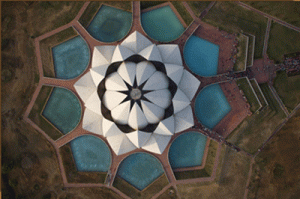
The pre-strung mandala design on this tile reminded me of a beautiful building in India that I would love to visit some day: the lotus temple near Delhi. Here is a photo of it from above and you can really see the mandala-ness of it. The blue-green areas are water pools.

This Baha'i House of Worship is the first in India and was opened to the public at the end of 1986. It now receives more visitors than the Taj Mahal, four million each year. I have difficulty with really big numbers so that translates into about 13,000 every day or 9 every minute. It is a bit of an architectural marvel and has received much attention in professional architectural, fine art, religious, governmental and other circles.

Here's a short video about it from Seven Wonders of India:

I pulled out another tile with the same string on it and drew a zendala inspired by this building. I think the Opus curlicues don't work so I might try it again.
Tangles: Auras, Caviar, Cubine variation, Opus, Tipple, Tri-dots

I've printed the arial photo above in black-and-white and made a mandala template that is of this building. Because of the angle of the photo it's slightly irregular, which will be interesting to work with. It will be 10 or 12 inches across. If it turns out well I'll show you, but it may be a while!

Thursday, May 19, 2011

Jack Wise, Artist

I have long enjoyed the intricate mandalas painted by Jack Wise. In particular I like how he often flows the same pattern through various color changes or shading.

In his early 30s Jack Wise moved from the United States to British Columbia, Canada, to pursue a life as a homesteader. That was in the early 1960s. After a brief hiatus, he returned to his painting with a passion that lasted the rest of his life. Wise was known for his calligraphy based upon Chinese brushwork, and for his colorful mandalas which embody a Buddhist cosmology. 

I originally had one of Jack Wise's mandala paintings on this blog post, but was requested to remove it. I did. Nonetheless, you can see some of his wonderful artwork here. Click on the yellow word "Contemplate", then on the yellow word "mandalas". Be sure to look at the detail images for each painting.

Sunday, January 23, 2011

Tibetan sand mandalas

If you've ever seen a real-life Tibetan Buddhist sand mandala I'm sure you were as impressed as I was. For me the truly amazing aspect is that they don't use any glue! The mandalas are large - about a meter across - and take days to construct. That's a LOT of loose sand! Don't dare bump the board it's on, or sneeze, or turn on a fan.

Photo courtesy of 'henryart' at creativecomons.org
I've had the privilege of seeing three being constructed. It's amazing to watch the monks at work. I discovered an interesting time-lapse video of one that took six days to complete. The whole thing comes together in about two minutes and the video is very interesting. One gets a much better idea of the process - and I think it's even more impressive - to stop by day after day to watch a mandala like this take shape slowly, as it must. It's interesting to be in the atmosphere of the monks' care and focused attention, although they are also friendly, smiling, and open to chat and explain. Then finally, once all that careful work is done, to watch it all being swept together.

Here's another video that's mostly sand mandalas. The sound track is by Phyllis Cole-Dai, an American pianist and composer. The music is lovely, as are the sentiments expressed, but what makes this video particularly special for me is that my painting "Whiz Bang" appears in it! It shows up near the end, just after the seven minute mark, and lasts about half a minute.

WHIZ BANG (c) 1995 Margaret Bremner; 24" square.
While mainly done in acrylic paint Whiz Bang does contain a few sections of colored sand. But I used glue! There is also a filigree gold-colored metal disk in the center. If I had to choose a dozen masterpieces of my work, this would be one of them.

Tuesday, January 18, 2011

Circle Symbolism

Black Elk,
a medicine man and visionary
of the Oglala Sioux, said, “Everything the
Power of the World does, is done in a circle.  The sky 
is round and I have heard that the earth is round like a ball,
and so are all the stars.  The wind, in its greatest power, whirls.
Birds make their nests in circles, for theirs is the same religion as
ours.   The sun comes forth and goes down again in a circle.   The
moon does the same, and both are round.  Even the seasons form
a great circle in their changing, and always come back again to
where they were.  The life of a man is a circle from childhood to
childhood, and so it is in everything where power moves
Our tipis were round like the nests of birds, and these
were always set in a circle; the nation’s hoop, a
nest of many nests where the Great Spirit
meant for us to hatch our
children.” 

*   *   *   *   *

Having neither beginning nor end, the circle has long been a symbol - across time and cultures - of eternity, wholeness, protection, and unity. It calls to mind things such as the full moon, the sun, the entrance or exit of a tunnel, the pupil of the eye, a hug. 

In striving towards the spiritual, humankind has, over the centuries, constructed circle-forms. In ancient times closed circles were considered protective, particularly for workers of magic.  A sorcerer's title dating from the first century B.C. was "circle-drawer". Defensive emplacements surrounding ancient towns were set in a circle. A circle is present on most talismans as it was believed to concentrate the magical power needed to summon the desired spirits or forces.

Rose window, Notre Dame. Photo: Mattis, WikiCommons

Many Gothic churches are renowned for their beautiful stained glass rose windows.


Dharma Wheel atop DaZhao temple in Hohhot. Photo: M.Bremner
Ancient, circular stone henges are found in Great Britain and elsewhere. 


Mosques are frequently domed as are some churches and other religious buildings.


TaiJi drain cover in a garden in China. Photo: M.Bremner

The Noble Eightfold Path of Buddhism is symbolized by a wheel with eight spokes: the Dharma Wheel or "Wheel of the Law".


The TaiJi (or ying yang) icon is symbolic of the interconnection between opposites such as male and female, youth and age, celestial and earthly, here and there.  

In Jungian psychology, the image of a circle inside a square represents the connection between our spiritual (circle) and physical (square) natures.


The circle is often associated with the idea of a protected or consecrated space. An expected ritual of visits to some holy sites is to circumambulate - or "walk around" - the area before entering the sanctuary. Wiccan practitioners initially cast (draw) a circle on the ground. These actions separate the sacred inner area from the worldly outer area.

A circle implies a center. As babies and young children we think the universe revolves around us.  Some of this feeling lingers, no matter how old we become!  Cuzco - the capital city of the ancient Incan empire - means “navel”. The Chinese call their land the Middle Kingdom.

Stretch out your arm and point at the horizon; slowly turn all the way around, tracing the horizon back to your starting point.  The horizon makes a circle around you. I like to turn the old expression "in the middle of nowhere" on it's ear - wherever we are, we are in the middle of everywhere.

Imagine yourself at the center of a sphere and the seven sacred directions of many north American aboriginals can be imagined: east, south, west, and north, (or: front, right, back and left), then Up toward the heavens and the Creator, Down toward the Earth, and Inward toward self-knowledge.

Now, go have a nice cup of coffee.

Fancy cappuccino. Photo: M.Bremner

(This post is, at least in part, for Denyse, who tends to use a lot of circles and couldn't remember why she found them so peaceful.)