Showing posts with label sacred geometry. Show all posts

Thursday, October 29, 2020

Phi again. PP11 follow-up

A bijou tile with Apacore centered 
at one of the four phi intersections.

Revisiting the golden mean through Project Pack 11 was such fun I wanted to do more!

The pack contains a "markus operandus" for locating the phi proportions on Zentangle tiles. Markus Operandus II can be downloaded here, for free, at the bottom of the page. I've added marks to mine so I don't have to rotate my paper in order to indicate all the phi lines. I may have it laminated. It looks like this.

It can be used not only with the new Phi tiles, but also with the classic square (also apprentice and bijou) tiles, as well as the triangular 3Z tiles. I wanted to give them a whirl. 

The proportions work on a square just as well as a rectangle. I'd done this years ago when my focus was mandalas. With the mandalas I used all four phi lines to create the working space:

Here's a mixed media painting from that time using these phi ratios.

Pro Fanis  •  ©1998
30" (76 cms) square; acrylic and collage

I've been fascinated with sacred geometry and the golden mean for many years. Delighted to revisit it in this project pack, I created a number of square tiles. 

Using the same four lines as above I did a classic-size tile. You can see Hollyhock in the corners, Icantoo in the rectangles, and the center connects it all.

Tangles: Hollyhock, Icantoo, and hints of
Crescent Moon, Pearlz, and Sanibel

I had a gray tile with a mauve wash. It struck me that somewhere near the 'center' of the flower shape might be a phi intersection. Here is the finished tile, with backwards steps to the mauve wash.

Tangles: Aquafleur, Pearlz, Pokeleaf

This is an eco-dyed tile that I subdivided into various phi-measured sections. I used Moonlight pens and gold ink as well as brown and sepia micron pens.

But triangles? The kit says it works with triangles, too. I don't see why not, but I'd never thought to try it before. On a rectangular shape, there are four phi intersections (shown above). I discovered that with a triangle, there are three.
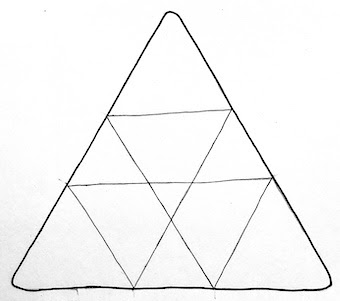
The black and white 3Z tile below has the tangle Ayame, but instead of beginning it at the center I began at one of the intersections. On the tan tile, I used the six notches at the perimeter as places to begin the droplet shapes.

I'm grateful to Zentangle for reintroducing me to divine proportion. I plan to do a lot more with these measurements.

Wednesday, October 14, 2020

Project Pack 11 - Phi ratios

When I returned home after three weeks away, Project Pack 11 was waiting for me! I quickly opened it to see what treasures lay inside. Of course! Why didn't I think of that? Phi-dimension tiles! I love sacred geometry. I even have some golden mean rulers.

Having been away, I found myself rather inundated with Things To Do and wasn't able to enjoy this immediately. But eventually I had a great time!

Day One: Dividing the tile according to phi ratios and drawing Pokeroot (I used Pokeleaf).

Tangle: Pokeleaf

Day Two: Drawing the tangle Gourdgeous along one of the phi lines. In Canada we call this a "goord" while in the US it's a "gord". I've realized that the name of this tangle is "gorgeous", not "goordjus"! 😜

Tangles: Black Pearlz, Gourdgeous, Krli-Qs

Day Three: Drawing on the back of the tile, following pre-strung the nautilus spiral using Crescent Moon. I got inspired and drew a Gourdgeous nautilus spiral on the "back" of this tile, actually the intended "front".


Day Four: Drawing a Hollis-inspired, droplet-ended Mooka, then adding color with colored chalk pencils. I added a border of Doodah. On one of the phi intersections I added the tangle Within in gold.

Tangles: Doodah, Within, Auras, and
a droplet mash-up of Mooka and Hollis

Day Five: Ing, along one of the phi lines, filling the triangles in various ways, then adding color. It's interesting how it  ended up in the center of the tile anyway. I like Ing a lot, so I did two. 😊 In the first, two phi intersections are indicated by the Black Pearlz; in the second, by the Pearlz rings.

Tangles: Black Pearlz, Ing, Pearlz, Auras, elements of Tripoli,
and Archimedian spirals

Day Six: Drawing a square around one of the phi intersections and creating a square grid around it.  Then, filling alternately with Cubine and a variation of Well, sort of.


Day Seven
: A diagonal line passing through two of the phi intersections, then subdividing the tile into smaller and smaller phi squares. In the leftover spaces in the center I kept seeing rectangles, so I drew the lines and added random Jalousie.

Day Eight: Molygon, and more, centered on one of the phi intersections. I couldn't not see a flower here so I added Icantoo.

Stay tuned for more Phi explorations!

Thursday, June 4, 2020

"Journey of an Old Soul" process

Some of the papers I used in my most recent eco-dye batch didn't stand up to the simmering as well as others. They had some frayed edges, tears, and small holes. I chose one of them to do a seven-circuit labyrinth.

This is the paper as it emerged from the dyeing, with a few initial pencil lines.

I chose Bosch for a border with a Sprouts/Mooka/Hollis mash-up in the corners. I outlined the labyrinth with a thin border between the paths, adding some details throughout.

Next I added a bit of color, three gems and some spring green Icantoos, as well as a metal leaf sun - or  is it a moon? Then more tangling in areas of the lines dividing the pathways, some shading to the corner sections, and some shading in the labyrinth itself.

That part done, I affixed the paper to a cradled birch panel, deciding to leave the wood grain showing. I added a small brass nail just inside the corners of the paper and drew a dark brown line around the edge of the wood. I finished the sides with a strip of cork.
I didn't like it. I thought it made it look like particle board - not an effect I wanted! I removed the cork and painted the sides bronze. To finish, I added matte varnish with a sprinkling of gold flecks.

Here is "Journey of an Old Soul":

Thursday, April 25, 2019

Nautilus shells in my Book

Like many, I find the nautilus spiral very appealing. It's that sacred geometry thing happening. I've used the image occasionally in my artwork.

I wanted to include a nautilus in my non-journal/non-sketchbook. This is the first two-page spread I've done in it. I didn't have that intention when I began but the book opened so nicely in the middle of a signature of pages that it was a no-brainer.

Here's the left-hand page:
Tangles: Crescent Moon, Pearlz, Tri-dots
Here's the right-hand page:
Tangles: Black Pearlz, Crescent Moon, Diva Dance, Flux, Marasu, Pearlz, Prestwood,
Printemps, Slowpoke, Tamisolo, Tipple, Tri-dots
And here's the two-page spread:

Sunday, June 17, 2018

Phi Day! .618

You may know that international Pi Day is March 14 each year, 3.14. (You can see my special triangular art for Pi Day 2017 here.)

I've long been interested in divine proportion (also called sacred geometry, the golden mean, etc.) and I think there should be an international Phi Day too, .618, June 18th. If it takes off, you can tell all your friends it started here!
Current page from my 2018 Tangle-a-Day calendar.
I chose Phicops for the 18th in my Tangle-a-Day calendar because the name starts with Phi and the inspiration for it is related to shells and golden proportion. Step-outs for the tangle Phicops are here. On this calendar page I actually worked backwards, beginning with the 18th, then the nautilus spiral on the 17th, and ending with part of the spiral and Paradox on the 16th.
Tangles: Phicops
.618 (or 1.618) is the number associated with sacred geometry, even though divine proportion is about relationship and proportion, not measurement. The number is the short version of the infinitely long and non-repeating decimal places.

The Golden Mean is essentially the division of a line into two unequal parts.  The ratio of the whole line to the large part is the same as the ratio of the large part to the small part. The result is an irrational number: 1:0.6180339… 
.618 is very close to two thirds.  Many art instructions recommend placing major objects approximately one-third of the way from either side, and one-third of the way up or down.  This is called the Rule of Thirds and makes the composition more pleasing to the eye.

-->
Saskatchewan landscape: canola field in bloom and The Tree, a prairie landmark.
The Rule of Thirds with the focal point at one intersection.
There is so much more to this once you delve into it: sunflower seeds, Greek philosophers, da Vinci, the Masonic Guild, eggs, arms and legs, Fibonacci, nautilus spirals, pine cones, piano keys, spiral galaxies, and on and on and on. (For more information and a great video on the Fibonacci number sequence see this post.)

In the meantime, have a PHIne day!

Friday, April 6, 2012

Dodecahedron completed!

Earlier I posted about a book of three cut-out shapes I'd bought. I had started working on one of them. You can see how this project began here. Now, finally, I can show you the finished product, hanging in a corner of my dining room swaying gently in the breeze from the heat register. I took a short video of it and attempted to upload it but it didn't work. Too bad.

Tangles: too many to mention!

Some polysyllabic (many syllables) words, for those interested in such things. 
In my earlier post I wondered what shape this was; the book called it an icosahedron (20-sided shape) but I didn't think so. I finally figured out that it is a dodecahedron (12-sided shape), but not a simple one. The angles connecting each yellow pentagon (5-sided shape) have been pushed in, creating the blue folded diamond shapes and yellow stars instead of pentagons. I expect there is a proper geometric term for this shape, but I don't know what it is.

Thursday, February 2, 2012

Fibonacci


LEONARDO PISANO FIBONACCI
(pronounced FIB-on-AT-chee)
Image from
http://www.gap-system.org/~history/PictDisplay/Fibonacci.html

Leonardo Pisano is better known by his nickname Fibonacci. He was born in Italy but educated in North Africa where his father held a diplomatic post. Fibonacci was taught mathematics in Bugia, an Algerian port city. He travelled widely with his father and recognised the enormous advantages of the mathematical systems used in the countries they visited. 

Fibonacci ended his travels around the year 1200 and returned to Pisa. There, he wrote a number of texts which played an important role in reviving ancient mathematical skills and made significant contributions of his own. Of his books, some no longer exist, but we still have copies of Liber abaci written in 1202. A mathematical problem in Liber abaci led to the introduction of the Fibonacci numbers and the Fibonacci sequence for which he is best remembered today:
"A certain man put a pair of rabbits in a place surrounded on all sides by a wall. How many pairs of rabbits can be produced from that pair in a year if it is supposed that every month each pair begets a new pair which from the second month on becomes productive?"
Trying to figure out things like this muddles my brain and neurons go off like holiday fireworks. I generally have to draw pictures with arrows, so I'll take it from the experts that the resulting sequence is 1, 1, 2, 3, 5, 8, 13, 21, 34, 55, 89, 144 and so on. In this sequence each number is the sum of the two preceding numbers. It appears in many different areas of mathematics and science. It relates directly to the growth patterns of trees, shells, flowers and animals, the proportions of human bodies and what we perceive as visually appealing or beautiful, and so much more.

You may have noticed that the Zentangle kit contains 34 blank tiles. You can buy tiles alone in packs of 55.

Here is a beautiful video that gives an overall impression, and a bit of hard information, about the Fibonacci numbers and sacred geometry. (Go full screen. It's worth it.)


Wednesday, December 7, 2011

Icosahedron?

You may recognize that word from the Zentangle kit. The kit comes with an icosahedron die and a legend for when you just can't think which tangle to do next.

An icosahedron is a 3-D shape with 20 sides. At the right is a diagram of the most simple version, with flat faces. They can also be truncated (which flattens the points into pentagons) or stellated (which pulls the faces out into points and makes it star-like). The measurements are related to sacred geometry and the Platonic solids. Fascinating! I love these 3D geometric shapes.


I also love second hand stores. At one I bought a book - Cut and Assemble 3-D Star Shapes - made of heavy cardstock. It contains the parts required to cut out and construct three different shapes.

The blue background of the
book cover doesn't help much.


Lovely and fascinating, but no doubt more lovely and more fascinating if tangled first! I started drawing in the book (parental *gasp*).

The book calls all three shapes icosahedra, but the particular one I'm starting with has 12 yellow faces (and 30 blue faces). Looks like a dodecahedron (12 sides) to me.


I scribbled in the book (parental *gasp* #2) : pencil strings over the stars. I'm using black ink on the yellow parts, but the blue is fairly dark so I'm using white there. Here's part of a page I've tangled so far.


I'll post a photo when this piece is tangled, constructed and hanging from the ceiling.